

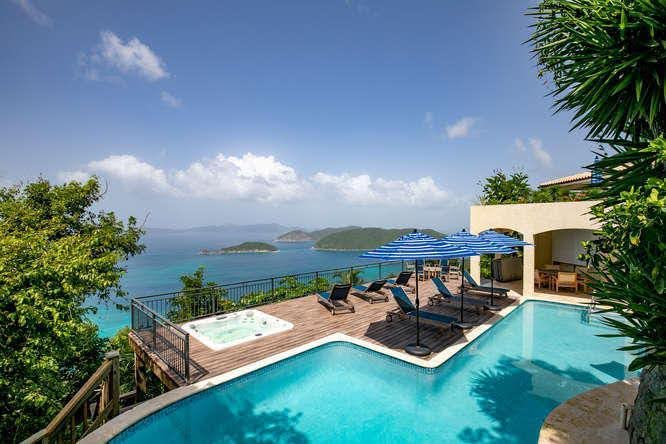
Those in the market for a second home or rental property often have their sights set on St. John, USVI, where there’s strong income potential and long-term value.
Real estate in St. John, U.S. Virgin Islands (USVI) is one of the most coveted in the Caribbean luxury market. Plus, with roughly two-thirds of the island designated as national park land, available residential land is scarce.
It’s typical for investors to develop rental properties around the island, which is quite a lucrative venture. In 2024, USVI welcomed 2.6 million visitors — an 8.9% increase from the previous year.
But before you start making offers for homes for sale in St. John, USVI, there are five key questions you should ask yourself before buying.
1. What kind of rental demand can I expect?
In St. John’s tourism-driven economy, investing in vacation rentals is quite lucrative.
Recent data on short-term rentals on St. John usually maintain an average monthly occupancy rate of over 60% and an average daily rate of nearly $900.
Short-term rentals benefit from a constant flow of tourists, especially during peak travel months from December through April.
2. What are the zoning and short-term rental regulations in St. John?
USVI divides land into specific zoning categories, each dictating how a property can be used, how dense development can be, and what kind of structures are allowed.
Key zoning categories in St. John
- Residential (R): For housing developments, ranging from single-family homes to apartments and condos.
- Waterfront (W): Highly regulated, including a mandatory 50-foot setback from the high-tide line or first sign of vegetation — a crucial detail for buyers considering coastal properties.
- Agricultural (A): Primarily used for farming and other agricultural activities. It’s usually the most restrictive.
- Business (B): This zoning, normally covering retail and office space, comes with guidelines on building size and setbacks.
- Commercial (C): This category can cover a broader range of commercial activities, which includes mixed-use development.
- Industrial (I): For investors looking to venture into manufacturing, warehousing, and other heavy-duty uses.
In residential zoning, here are some specific examples of construction specifications and limits:
- R1: Requires a minimum ½-acre lot, allows up to two dwelling units, and limits buildings to two stories with 15-foot setbacks on all sides.
- R2: Requires 10,000 square feet minimum, allows two dwelling units, and also caps height at two stories with 15-foot front and 10-foot side/rear setbacks.
- R3: Designed for higher-density housing, requiring at least 6,000 sq. ft. and allowing up to 80 persons per acre. Building height may reach six stories, depending on local ordinances.
- R4: Even higher density, allowing up to 120 persons per acre, with three-story height limits and setbacks governed by local ordinances.
Short-term rental regulations
Vacation rentals in the USVI require a short-term rental permit from the Department of Licensing and Consumer Affairs (DLCA).
Since July 2021, all short-term rentals — defined as stays under 90 days — must have a valid business license issued by the DLCA. These licenses fall into two categories based on guest capacity:
- Short Term Rental A for properties that accommodate five or more guests; and
- “Short Term Rental B” for rentals that host up to four guests.
In addition, short-term rental operators must comply with zoning approvals, pass fire safety inspections, and ensure compliance with the 12.5% Hotel Room Occupancy Tax.
3. What are my financing options?
Financing a property purchase in St. John isn’t exactly the same as the mainland. While traditional mortgage products (conventional and jumbo loans) are available, options may be fewer, and the process can take longer due to local infrastructure constraints.
Still, there are some financing options available to buyers:
- Local banks and credit unions. These institutions typically require more extensive documentation, larger down payments and longer processing times. It’s a good choice for residential property and the only option for undeveloped land.
- Private and non-bank jumbo loans. It’s also possible to go for private financing, which often has fewer bureaucratic hurdles. But there’s a preference for locations in tourist areas or waterfront homes. Direct lenders and mortgage brokers are the most efficient method to obtain conventional and jumbo financing with favorable rates. Minimum loan amounts typically start around $750,000, with financing generally available for up to 50% of a property’s value.
4. What can I expect when it comes to insurance and storm preparedness?
Owning real estate in St. John means preparing for stormy weather and potential hurricanes. The Atlantic hurricane season runs from June to November, with activity peaking between August and October.
Because of storm risks and a tighter “hard-market” insurance environment, premiums for wind, flood, and full hurricane insurance often come at significantly higher prices than on the mainland.
For that reason, homes built with storm-resilient features — reinforced roofs, hurricane-rated windows and doors, concrete or elevated foundations — tend to offer better protection and may represent stronger long-term value in this environment.
5. How much does real estate appreciate in St. John, USVI long-term?
Long-term appreciation is a top consideration for those exploring homes for sale in St. John. While year-to-year fluctuations occur, the overall trajectory for USVI shows steady upward movement over the past decade (2010-2020).
According to U.S. Census data, the $290,600 median home value in USVI was the highest among the four Island Areas (includes American Samoa, Commonwealth of Northern Mariana Islands, and Guam).
In particular, St. John maintained the highest median home value in the territory at $591,200 — above St. Thomas ($357,000) and St. Croix ($247,100). This reflects St. John’s unique profile: a smaller, more exclusive island with far fewer homes, where individual high-value transactions can significantly influence median numbers.
Ready to invest in St. John, USVI real estate? Let’s talk.
A real estate investment in the island offers strong income potential and long-term value, but only if you know where to look.
Karye Carney, a seasoned St John, USVI Realtor affiliated with Holiday Homes, the island’s oldest — yet most forward-thinking — real estate firm, is here to guide you every step of the way.
Call 340.513.1960 or send an email to make your next real estate move easy. Explore St. John now.